Horse-Human Partnerships
When the Pattern Belongs
to the Partnership
Why some patterns make more sense when we look at horse and human together.
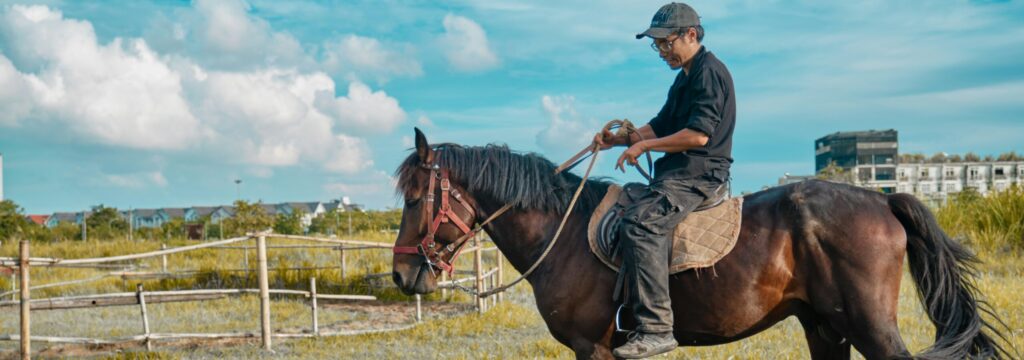
The pattern may be shared
Horse people are trained to look carefully. We notice a shortened stride, a reluctance to bend, a rider who always lands more heavily on one side, or a horse who becomes tense in a particular transition. Our first instinct is often to locate the problem in one body: the horse’s back, the rider’s hip, the saddle, the training plan.
Those are important places to look. But sometimes the pattern does not belong neatly to either the horse or the human. It belongs to the partnership.
A rider may carry tension through the right side of the neck and shoulder. Over time, the horse may organize around that asymmetry. A horse may protect an old area of discomfort, and the rider may begin compensating without realizing it. Neither is pretending. Neither is necessarily the sole cause. Two nervous systems and two moving bodies have adapted to one another.
Why treating one body may not be the whole answer
Individual care still matters. Veterinary assessment, saddle fit, hoof care, dentistry, rehabilitation, training, and bodywork all have essential roles. SIM Sessions are not a replacement for any of them.
What we have observed, however, is that a pattern may return when only one side of the partnership changes. The horse receives excellent work, then reconnects with a rider whose familiar compensation is still present. Or the rider feels freer after a session, then returns to a horse who is still protecting the same movement. The pair can unintentionally rebuild the pattern because it has become part of how they coordinate.
That does not mean the human caused the horse’s problem, or that every equine issue is a reflection of the owner. Horses have their own histories, injuries, temperaments, and experiences. Humans do too. The useful idea is simpler: when two bodies repeatedly work together, each can influence how the other organizes.
What SIM Sessions add
In a SIM Session, one practitioner works with the human while another works with the horse. The practitioners communicate throughout the session, comparing what they are noticing in real time.
If tension changes in the rider’s pelvis and the horse responds through the hindquarters, that response can be observed immediately. If the horse repeatedly draws attention to an area or becomes more settled as the human releases a pattern, the team can slow down and explore the connection. The goal is not to force a meaning onto every movement. It is to let the horse-human interaction provide additional information.
This approach gives both bodies support at the same time. Rather than asking one member of the partnership to adapt around the other, the session creates an opportunity for the pair to find a different organization together.
The horse is a participant, not a prop
Horses are exceptionally responsive to posture, pressure, attention, rhythm, and changes in the environment. This sensitivity is part of how they stay safe and communicate socially. In a session, that responsiveness may help reveal when something in the partnership has shifted.
We do not assume that every yawn, movement, or change in expression has one fixed interpretation. We watch for patterns, timing, and repetition. We also respect the horse’s comfort, boundaries, and individual needs. The horse is not there merely to produce an experience for the human; the horse receives support and has a voice in the process.
What change can look like
A useful shift is not always dramatic. Sometimes the rider feels more even through the seat. The horse may move with more fluidity, stand more quietly, breathe more deeply, or engage with the person differently. A familiar task may feel easier. A persistent pattern may become clear enough that the client knows what to address next with a veterinarian, trainer, bodyworker, or other professional.
One session cannot promise a particular result, and lasting change depends on many factors. But when a pattern truly belongs to the partnership, supporting both horse and human together can reveal options that are difficult to see while looking at either one alone.
Sometimes the breakthrough begins when we stop asking who owns the pattern—and start listening to what the partnership is showing us.